
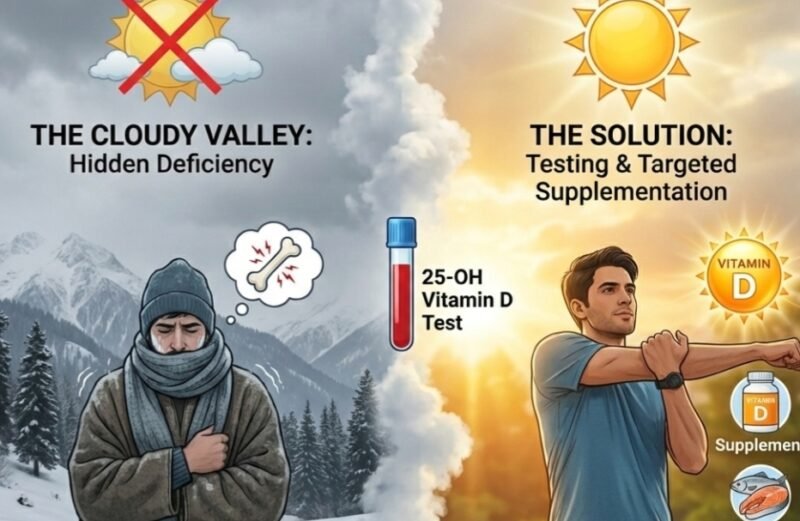
The “Sunshine Vitamin” Problem in a Cloudy Valley: Why Kashmiris Are Running Low
Subtitle: We live in one of the most beautiful places on earth, but our geography and lifestyle might be keeping us from getting enough of the “Sunshine Vitamin.” Here’s what you need to know about Vitamin D.
Living in the Valley, we know the rhythm of the seasons better than anyone. We cherish the golden warmth of summer and brace ourselves for the long, grey embrace of winter. But while we prepare our homes with bukharis and our wardrobes with pherans, our bodies are often left silently struggling against a hidden deficit: Vitamin D deficiency.
It seems ironic. How can people living in such a naturally beautiful, open environment be deficient in the very vitamin provided by the sun?
At Kashmir Online Lab, we see the test results every day, and the numbers tell a clear story. Vitamin D deficiency is becoming a silent epidemic in Kashmir, affecting our bones, our muscles, and our ability to fight off illness.
Why the Valley struggles with the “Sunshine Vitamin”
Vitamin D is unique because your body is designed to manufacture it when your skin is exposed to direct sunlight. However, several factors in Kashmir create a “perfect storm” for deficiency:
- Geography and Season: For nearly half the year (late autumn to early spring), the sun in Kashmir is often too weak or hidden behind clouds to stimulate enough Vitamin D production. The UV index drops, and the “sunshine window” becomes incredibly small.
- The Chill Factor: Even when the sun is out in winter, it’s cold! We naturally cover up. Between our traditional pherans, heavy jackets, and scarves, almost no skin is left exposed to absorb those vital rays.
- Melanin: Our skin tone naturally requires more sun exposure to produce the same amount of Vitamin D compared to lighter-skinned populations.
The Silent Signs: Is Your Body Crying for Help?
Because Vitamin D works behind the scenes, you might not realize you are low until the levels are critical. It doesn’t always show up as a dramatic illness. Instead, it often whispers through nagging discomforts:
- Unexplained Bone and Back Pain: Do you feel a deep, aching pain in your bones or lower back that just won’t go away? That isn’t just “getting old”—it could be your bones starving for calcium, which they can’t absorb without Vitamin D.
- Muscle Weakness: Feeling heavy or fatigued after simple tasks? Low Vitamin D can affect muscle function, making you feel physically drained.
- The “Blues”: There is a strong link between low Vitamin D and mood dips, especially during our long, grey winters (often called Seasonal Affective Disorder).
The Immunity Connection: Your Shield During Flu Season
We often think of Vitamin D strictly for strong bones, but it is also a powerhouse for your immune system.
Think of Vitamin D as the “key” that turns on your body’s defense mechanisms. It helps activate the T-cells that fight off viruses and bacteria. In a place like Kashmir, where seasonal flu and respiratory infections are common during winter, having adequate Vitamin D levels is like having an extra layer of armor against getting sick.
If you find yourself catching every cold that goes around, your Vitamin D levels might be the weak link in your defense.
Testing vs. Guessing: The Danger of Self-Medication
In Kashmir, we have a habit of being our own doctors. We hear a neighbor is taking a Vitamin D sachet, so we start taking one too.
This is a dangerous practice.
Vitamin D is a fat-soluble vitamin, meaning it gets stored in your body’s fat tissues. Unlike Vitamin C, which you just pee out if you take too much, Vitamin D can build up to toxic levels if you overdo it (a condition called Hypervitaminosis D). This can lead to kidney stones and calcium buildup in your arteries.
On the flip side, many people take supplements that are too weak to fix a severe deficiency, leaving them unprotected.
The only way to know the correct dose is to know your starting number.
Take the Guesswork Out of Your Health
You don’t need to wonder if the grey skies are affecting you.
- If you are below 20 ng/mL: You are deficient and likely need a prescription-strength booster.
- If you are between 20-30 ng/mL: You are insufficient and need a maintenance plan.
- If you are above 30 ng/mL: You are doing great!
At Kashmir Online Lab, our Vitamin D test is quick, precise, and can be done from the comfort of your warm home. We’ll help you get the exact number you need so you can supplement safely and effectively.
Don’t let the clouds dictate your health.
👉 Book your Vitamin D test today. Let’s keep your bones strong and your immunity ready for whatever the season brings.