
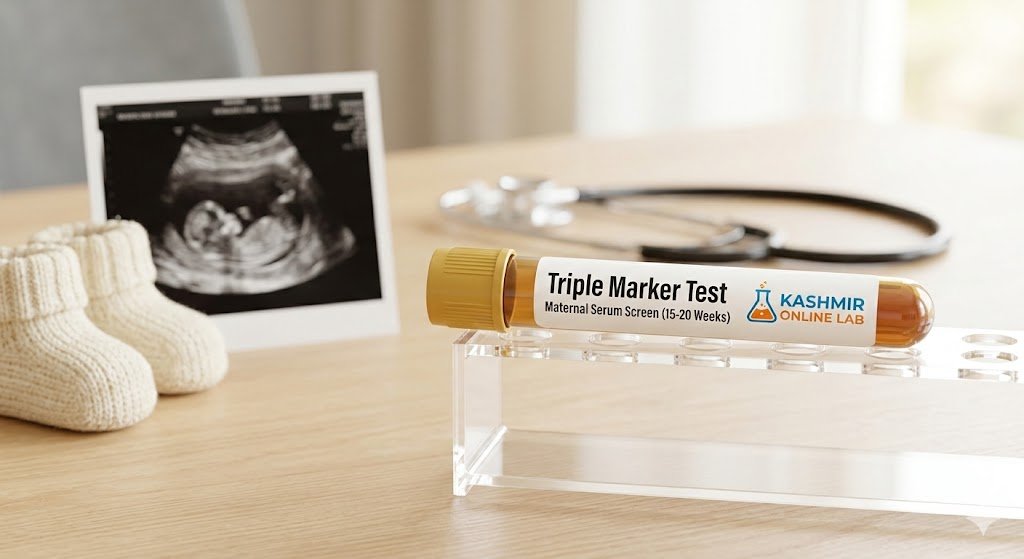
Description
The Triple Marker Test is an essential prenatal screening performed during the second trimester of pregnancy (weeks 15-20). It analyzes a sample of the mother’s blood to assess the risk of the baby having certain chromosomal abnormalities, such as Down syndrome, or open neural tube defects like spina bifida.
Overview: The Triple Marker test is a screening tool, not a diagnostic test. It does not tell you if your baby has a problem; it tells you the statistical chance or risk of certain conditions. It works by measuring the levels of three specific substances in the pregnant woman’s blood that are produced by the fetus and placenta. The results are combined with the mother’s age, weight, ethnicity, and gestational age to calculate risk.
What is measured (The “Triple” Markers):
-
Alpha-fetoprotein (AFP): A protein produced by the fetus’s liver. High levels may indicate neural tube defects.
-
Human chorionic gonadotropin (hCG): A hormone produced by the placenta. High levels are often associated with Down syndrome.
-
Unconjugated estriol (uE3): A form of estrogen produced by both the placenta and the fetus. Low levels may indicate chromosomal abnormalities.
Clinical Significance:
-
Neural Tube Defects: Helps screen for conditions where the baby’s spine or brain doesn’t develop properly, such as Spina Bifida or Anencephaly.
-
Chromosomal Abnormalities: Assesses the risk for Down syndrome (Trisomy 21) and Edwards syndrome (Trisomy 18).
-
Guiding Decisions: A “screen-positive” result indicates a higher risk and usually leads to recommendations for further diagnostic testing, such as a high-resolution ultrasound or amniocentesis, to confirm a diagnosis.
When is this test recommended?
-
Timing is Crucial: It must be performed between the 15th and 20th weeks of pregnancy. The ideal time is usually between weeks 16 and 18 for the most accurate results.
-
Routine Care: It is often offered as part of standard prenatal care to all pregnant women.
-
Higher Risk Pregnancies: It is strongly recommended for women over age 35, those with a family history of birth defects, or those with diabetes.
Sample Requirements:
-
Specimen: Serum (Maternal Blood).
-
Container: Gold Top (SST) or Red Top Tube.
-
Preparation: No fasting is required.
-
Crucial Data Required: For accurate risk calculation, the lab must know the mother’s exact Date of Birth, weight, diabetic status (insulin-dependent or not), and the accurate Gestational Age (preferably determined by a recent ultrasound dating scan, not just last menstrual period).