Description
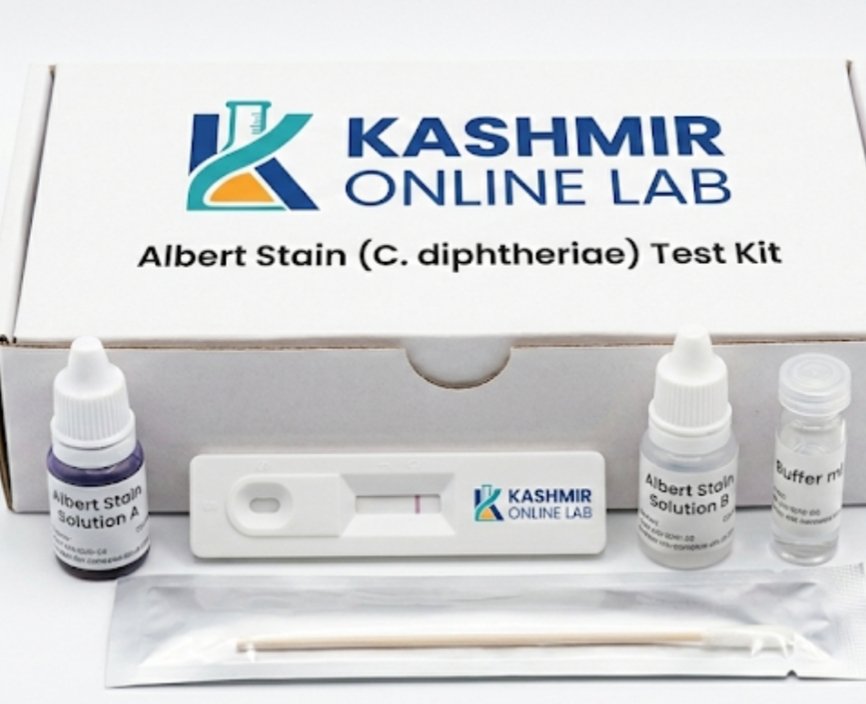
Albert Stain (C. Diphtheriae) Test
Albert Stain is a specialized bacteriological staining technique used primarily for the presumptive diagnosis of Diphtheria. It is designed to detect the characteristic metachromatic granules (volutin granules) found in Corynebacterium diphtheriae, the bacteria responsible for the disease.
Test Description
- Primary Use: Rapid identification of C. diphtheriae from throat swabs or culture isolates.
- Target: It specifically stains metachromatic granules (also known as Babes-Ernst bodies or food granules) present at the poles of the bacteria.
- Turnaround Time: Immediate (Microscopy based).
Principle
The test utilizes two main solutions to differentiate the bacterial structures:
- Albert’s Solution A: Contains Toluidine Blue and Malachite Green. The Toluidine Blue stains the acidic granules, while Malachite Green stains the cytoplasm.
- Albert’s Solution B: Contains Iodine, which acts as a mordant to darken the stained granules, making them stand out sharply against the bacterial body.
Procedure Overview
- A smear is prepared from a throat swab or culture on a glass slide.
- The slide is flooded with Albert’s Solution A for 3–5 minutes.
- The stain is drained (without washing), and Albert’s Solution B is applied for 1 minute.
- The slide is rinsed with water, air-dried, and examined under an oil-immersion microscope.
Interpretation of Results
A positive result for C. diphtheriae shows a distinct appearance often described as “Chinese Letter patterns”:
- The Bacteria: appear as green, rod-shaped bacilli arranged in V, L, or palisade shapes (resembling Chinese characters).
- The Granules: appear as bluish-black or dark purple dots located at the ends (poles) of the rods.
Clinical Significance
- Diphtheria Diagnosis: This test is critical for the early detection of Diphtheria, a serious infection that causes a thick covering in the back of the throat and can lead to breathing difficulties, heart failure, and paralysis.
- Outbreak Management: It helps public health officials quickly confirm cases during outbreaks to initiate immediate treatment and isolation.